Wooden Cabinet 25% Surtax: What Canadian Importers Need to Know
The Government of Canada has introduced a provisional 25% surtax on certain wood cabinet, vanity, and related subassembly imports. For Canadian importers, retailers, contractors, builders, distributors, and manufacturers that source finished or unfinished cabinetry from abroad, this measure may significantly affect landed costs, customs accounting, product classification, and supply chain planning.
Effective July 31, 2026, the surtax applies to covered goods imported into Canada for commercial purposes. The measure was introduced while the Canadian International Trade Tribunal conducts a safeguard inquiry into whether increased imports are causing, or threatening to cause, serious injury to Canadian producers. During this provisional period, importers should not treat the new surtax as a routine tariff update. It is a time-sensitive compliance issue that requires careful review of product scope, country of origin, valuation, documentation, and CARM declaration practices.
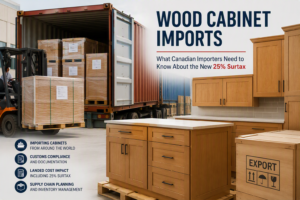
What Is the New Wood Cabinet Surtax?
The Certain Wood Cabinet and Vanity Goods Surtax Order imposes a surtax equal to 25% of the value for duty on qualifying wood cabinet and vanity goods. The value for duty is determined under the Customs Act, and the surtax is payable in addition to any regular customs duty, anti-dumping or countervailing duties, excise tax, and GST that may otherwise apply. In practical terms, a shipment with a value for duty of $10,000 could attract an additional $2,500 in surtax before GST is calculated.
The provisional safeguard measure applies for up to 200 days beginning July 31, 2026. After that period, the surtax will continue only for goods that the Tribunal determines are being imported under conditions that cause or threaten serious injury. If no injury finding is made, the surtax will cease as of the Tribunal’s finding date.
Products That May Be Covered
The surtax applies to certain cabinets and vanities made wholly or partly of wood products and intended for permanent installation. This includes goods for kitchens, bathrooms, closets, and similar spaces where the product is designed to become an integral part of a building or structure. A wood cabinet does not need to be permanently fixed forever to fall within scope. If it is intended for installation in a fixed location, it may be covered even if it can later be removed, relocated, or replaced.
Covered goods may include frames, cabinet boxes, doors, drawers, drawer components, back panels, end panels, and certain desks, shelves, or tables attached to or incorporated into cabinets or vanities. The measure can apply whether goods are assembled, unassembled, flat-packed, ready to assemble, finished, unfinished, complete, or incomplete. It can also apply when the goods include non-wood components such as metal, marble, glass, plastic, resin, plumbing fixtures, sinks, faucets, or countertops.
Tariff Classifications Importers Should Review
Importers should immediately review shipments classified, or potentially classifiable, under tariff classification numbers 9403.40.00.10, 9403.60.10.31, 9403.60.10.39, and 9403.91.00.90. Covered goods classified under Chapter 99 may also be subject to the surtax if they would otherwise fall under one of these listed tariff items.
Classification should not be based only on product descriptions used for sales or marketing. A product described commercially as modular, semi-permanent, decorative, or furniture-style may still require deeper analysis. Customs classification depends on the nature of the goods, their materials, their intended use, and how they are presented at importation. If your company imports any wood cabinet product or subassembly, now is the time to verify your tariff database, vendor descriptions, product specifications, and accounting instructions.
Important Exceptions
The surtax does not apply to qualifying goods originating in Canada, the United States, Mexico, Chile, Israel or other Free Trade Agreement beneficiaries, or a developing country or territory listed in Schedule 2 of the Order. Origin is determined under Canada’s applicable marking rules, and importers should maintain proof of origin before claiming an exemption.
Other exceptions may apply to goods that were in transit to Canada when the measure came into force, casual non-commercial goods, goods classified under Chapter 98, freestanding furniture not intended for permanent installation, certain aftermarket organizers and accessibility accessories, decorative solid wood accessories, separately imported non-wood hardware, and certain shallow wall-mounted medicine cabinets with mirrors. However, these exceptions are fact-specific. Importers should avoid assuming that a product is excluded without reviewing the details.
CARM Accounting and Safeguard Code 26169A
Covered goods must be declared as subject to a safeguard when the Commercial Accounting Declaration is submitted through the CARM Client Portal, Electronic Data Interchange, or an Application Programming Interface. The applicable safeguard code is 26169A, and the safeguard amount must be entered in field 87, “Safeguard.” It should not be entered in field 85, which is used for standard surtaxes.
This distinction matters because incorrect reporting can create reassessment risk, penalties, interest, and avoidable delays. When using a self-declaration process, the importer remains responsible for calculating the safeguard amount correctly. Where goods qualify for an exception and are not subject to another surtax, they should be declared accordingly at the time of accounting.
Why Documentation Matters
The Canada Border Services Agency may examine goods at import or conduct post-release verifications. Importers may need to support tariff classification, value for duty, origin, product scope, exemption eligibility, and the calculation of the safeguard amount. Useful records may include commercial invoices, bills of lading, cargo control documents, origin certifications, product literature, installation instructions, technical drawings, purchase orders, and supplier declarations.
For in-transit claims, documentation should show that the goods were bound for Canada and under carrier control when the surtax took effect. Without adequate evidence, CBSA may deny the exception and reassess duties. A customs broker can help importers identify documentation gaps before entries are filed or adjusted.
Practical Steps for Importers of Wood Cabinet Products
- Review current and planned imports against the affected tariff classifications.
- Confirm whether each wood cabinet, vanity, or component is intended for permanent installation.
- Verify country of origin under Canadian marking rules before claiming an exemption.
- Update landed-cost calculations to include the 25% surtax and GST impact.
- Confirm that CARM declarations use safeguard code 26169A and field 87.
- Retain evidence for in-transit, origin, classification, and product-scope claims.
- Review recent entries and submit adjustments where the surtax was incorrectly assessed or omitted.
How Orbit Brokers Can Help
A customs broker can help determine whether your wood cabinet imports are within scope, validate classification, review origin documentation, calculate the surtax, and ensure the safeguard is reported correctly in CARM. Brokers can also help identify possible duty relief or drawback opportunities where eligible, especially for Canadian businesses that re-export goods or use imported goods in qualifying activities.
The new surtax is more than a temporary cost increase. It is a compliance event that can affect pricing, supplier negotiations, purchase timing, accounting procedures, and customer commitments. Importers that act early will be better positioned to manage cost exposure, avoid customs errors, and respond quickly as the Tribunal process develops.
If your business imports wood cabinet, vanity, or related subassembly products into Canada, contact Orbit Brokers before your next declaration is filed.
Clayton Castelino is the author of this blog and Senior Vice-President of Orbit Brokers, where he leads the team with over two decades of experience in customs management and operations. Starting as a Customs Rater in 2004, he steadily advanced through the company, earning his professional customs broker designation and stepping into leadership roles. His deep industry knowledge and commitment to client service continue to guide Orbit Brokers’ growth and success.